Inside the Labs: How Engineers Fortified Reel-Based Games Against Manipulation Attempts
Written by Bianca Russell · Aug 12, 2026

Inside the Labs: How Engineers Fortified Reel-Based Games Against Manipulation Attempts
Reel-based games have long presented unique engineering challenges for security teams tasked with preventing unauthorized access and outcome alteration, and laboratories across multiple continents have responded with systematic testing protocols that simulate real-world interference scenarios while documenting every variable that could affect payout integrity. Researchers at facilities specializing in gaming hardware began by cataloging historical manipulation techniques ranging from mechanical interference to signal injection, then built controlled environments where each method could be replicated under observation to measure its impact on reel alignment and random number generation cycles.
Hardware Reinforcement Strategies
Teams focused first on physical components because reel assemblies offered direct points of contact that earlier designs left exposed to external tools, so engineers introduced reinforced locking mechanisms and tamper-evident seals that trigger immediate shutdown sequences when disturbed. Data from testing cycles showed that integrating optical sensors along reel paths reduced the success rate of forced rotations by detecting minute deviations in expected movement patterns, while multi-layered circuit boards with encrypted communication buses prevented external devices from overriding internal controls during live operation.
Additional layers came from material science applications where composite housings replaced standard metal casings, creating barriers that absorbed or dispersed energy from common probing instruments without transmitting force to internal reels. Laboratories documented these changes through thousands of repeated trials, confirming that the combined physical upgrades maintained operational reliability even after repeated stress testing that mimicked years of venue use.
Software and Monitoring Layers
Parallel development occurred in firmware architecture, where engineers replaced static code structures with dynamic verification routines that cross-checked reel position data against independent entropy sources at millisecond intervals. This approach caught discrepancies introduced through memory alteration attempts because any injected values failed to align with the continuous output stream generated by sealed hardware randomizers. Monitoring dashboards in lab settings displayed real-time graphs of reel behavior, allowing observers to identify anomalies such as repeated symbol clustering that deviated from statistical baselines established during initial calibration.
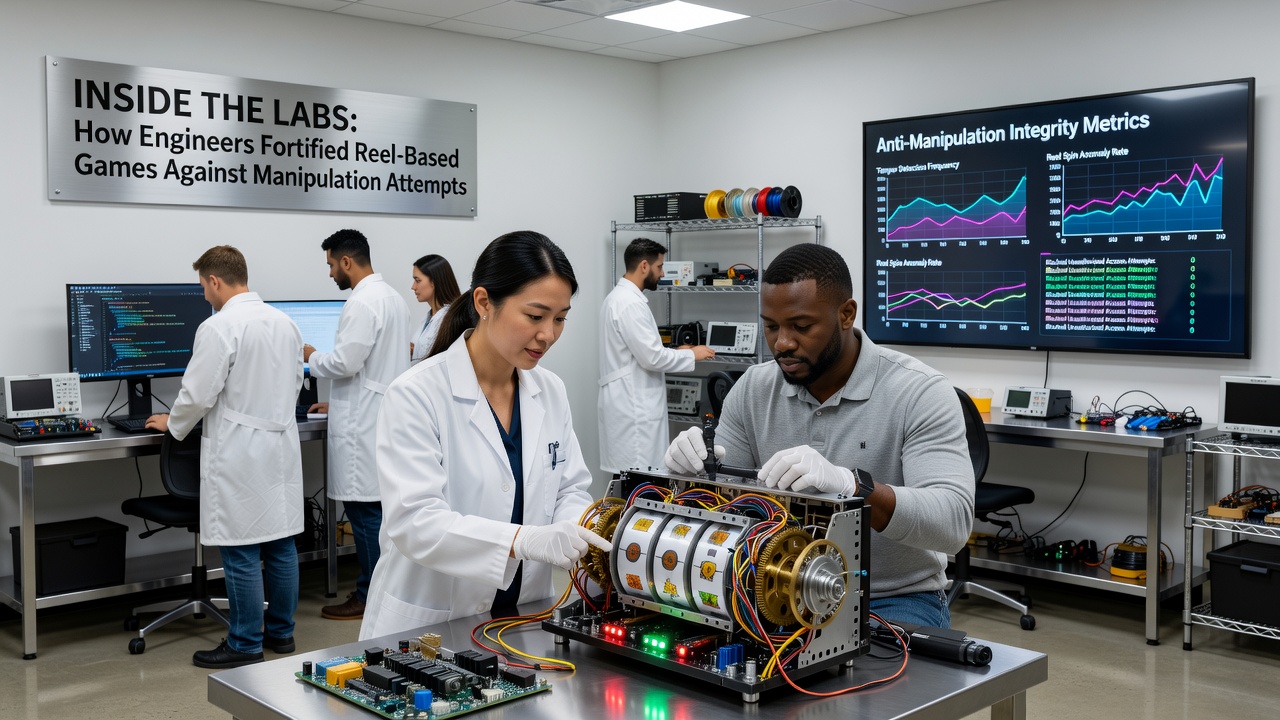
Integration with external audit systems further strengthened these defenses, since laboratories began feeding encrypted log files to independent verification platforms operated by regional regulators in places like Nevada and New Jersey. According to reports from the Nevada Gaming Control Board, such data streams enabled faster detection of pattern anomalies across deployed machines, prompting firmware updates before widespread issues emerged. Research institutions including those affiliated with the University of Nevada, Reno have contributed studies on entropy preservation that informed these monitoring enhancements, providing quantitative models for expected reel variance under normal conditions.
Simulation Protocols and Certification Updates
By August 2026 laboratories had standardized multi-stage simulation suites that combined electromagnetic interference, thermal variation, and network-based probing into single test sequences lasting several hours per unit. These protocols required machines to maintain certified payout percentages throughout each phase, with automatic logging of any deviation that exceeded predefined thresholds. Engineers noted that adding redundant power supply monitoring prevented attacks relying on voltage manipulation, as sudden fluctuations now activated protective circuits that halted reel movement and alerted venue staff through integrated notification systems.
Certification bodies in the European Union and Australia adopted similar frameworks around the same period, requiring manufacturers to submit detailed attack surface analyses before approving new reel-based models for commercial release. Figures from industry testing summaries indicate that machines passing these expanded evaluations showed measurable reductions in successful interference incidents during the first twelve months of deployment, although exact percentages vary by jurisdiction and machine type.
Ongoing Adaptations
Continuous refinement remains necessary because new manipulation vectors appear whenever hardware or software updates introduce fresh interfaces. Laboratories therefore maintain rotating teams that review field reports from operators and feed findings back into updated test matrices, ensuring defenses evolve alongside potential threats. This iterative process has produced machines equipped with self-diagnostic routines that run during idle periods, verifying sensor calibration and firmware checksums without interrupting player sessions.
Conclusion
The progression from basic mechanical locks to integrated sensor networks and encrypted monitoring represents a sustained engineering effort that continues to shape reel-based game design. Laboratories document each advancement through rigorous, repeatable testing that prioritizes measurable outcomes over assumptions, and the resulting systems now form the baseline for regulatory approval in multiple markets. Future iterations will likely incorporate additional machine learning elements for anomaly detection, yet the core principle stays consistent: every potential access point receives independent verification before deployment reaches public venues.